
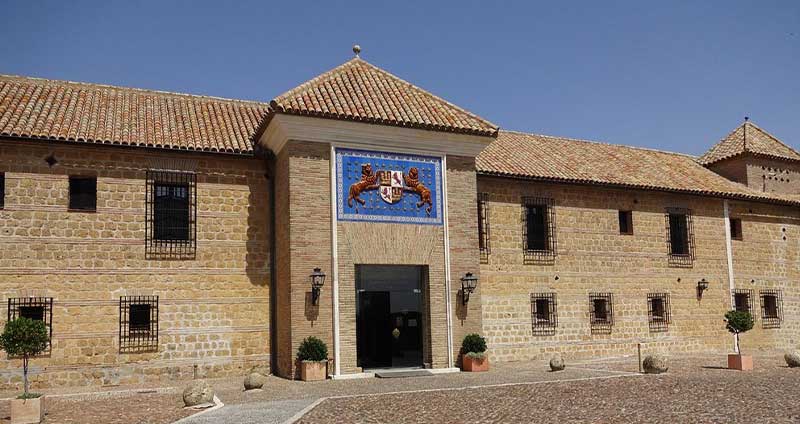
When the Past Becomes the Present
At the highest point of Carmona, where the seemingly endless panorama of the Andalusian plains unfolds before the observer, stands a fortress that has been guarding its stories for more than six hundred years. The Alcázar del Rey Don Pedro – or as it is officially called: Alcázar de Arriba – is not merely a historical monument. This is a place where time stood still, then came back to life, so that 21st-century travelers can experience what it was like to wake up in a royal palace in the Middle Ages.
From afar, approaching travelers can already see the massive stone walls that crown the little town. The winding network of narrow streets leads upward, moving away from the noise of modern life, until we finally stand before the monumental entrance. We step through a large, pointed horseshoe-shaped arch – the same gate through which knights, court ladies, and perhaps King Pedro himself passed one hundred and fifty years ago.
The Palace of the Cruel King – or Was He the Just?
King Pedro I, whom some called the Cruel and others the Just, had this fortified palace built during his eventful reign in the 14th century. History has treated this king with peculiar irony – depending on who tells his story, he was either a hero or a tyrant. He ultimately lost his life in a battle with his own illegitimate half-brother, who coveted the throne.
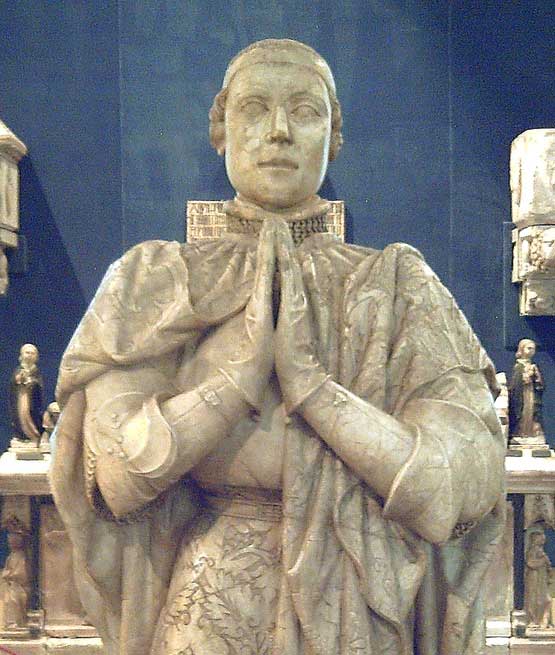
Peter of Castile | photo by: Luis García
But before his fate was sealed, Pedro, who once said that “a single loaf of bread would be enough to fill the stomach of every loyal subject of mine,” commissioned a castle to be built next to the ruins of an older Moorish fortification – to house his favorite mistress and their daughter together. He employed the same Moorish master builders who also constructed the Royal Alcázar of Seville. The result was stunning: a pleasing blend of Gothic and Moorish styles that continues to captivate visitors to this day.
The palace was later favored and used by other monarchs as well. The Catholic Monarchs, Ferdinand and Isabella, also stayed here, and they were the ones who built the artillery fort known as the cubete, as well as beautifying the palace rooms. The alcázar, therefore, embodied not just one king’s vision but served Spain’s most important rulers for generations.
Where History and Nature Meet
The historic town of Carmona is located just thirty kilometers from Seville, yet it feels like stepping into a completely different world. Andalusia is (after Switzerland) one of Europe’s most mountainous regions, but it is precisely around Carmona that those endless plains unfold, which for centuries formed the economic strength of Southern Spain. This agricultural treasure brought enormous wealth to the surrounding towns from generation to generation, all of which are filled with noble houses, palaces, and the extraordinarily decorated architecture of abbeys and churches.
At the highest point of Carmona, in the western part of the walled town, stands the alcázar. Looking up from the valley, it almost appears as if the castle naturally grows out of the ridge’s rock. This strategic location is no accident – the spectacular view of the Vega de Carmona opens from here, which no one can ignore.
The panorama opening from the castle is particularly breathtaking at sunset, when golden light sweeps across the Corbones River valley, and in the distance, the endless carpet of yellow wheat fields glows. This is the view that led many kings and rulers to choose this place as their retreat.
The Parador – Where History Meets Luxury
The alcázar’s story, however, did not end in the Middle Ages. Over the centuries, it endured numerous trials. In 1649, when Seville was struck by a plague epidemic, the fortification was used as a hospital and cemetery for the disease’s victims. Later, two devastating earthquakes – in 1504 in Carmona, then in 1755 the Lisbon earthquake – severely damaged the building. The latter, the Lisbon earthquake, caused such destruction that the castle was eventually abandoned.
The once magnificent stucco decorations and marble columns vanished without a trace. The palace slowly fell into ruin, and it seemed that history had put an end to this marvelous place.
But everything changed in the 20th century. On March 30, 1976, Mayor Francisco Ojeda Montero inaugurated the Parador del Alcázar del Rey Don Pedro. King Juan Carlos I and Queen Sofia of Spain also attended the ceremony – indicating how important this project was in preserving Spain’s cultural heritage.
The Parador concept is unique: Spain’s Paradores are a network of historic palaces, castles, and other monuments whose preservation and restoration are financed from hospitality revenues. This means that at the Parador de Carmona, half an hour from Seville, we ultimately sleep in a 14th-century Arab fortification, from which a spectacular bird’s-eye view of the town of Carmona unfolds.
Entering Another Time
Upon arriving at the Parador’s entrance, it is immediately apparent that this is not an average hotel. The massive stone gate, which once provided security for defenders against attackers, now welcomes guests – yet the historical atmosphere has lost none of its power. Much of the original outer walls remain, while the main building has been restored to create an incredible hotel.
The entire atmosphere is extraordinary: heavy, dark shutters and window blinds, stone floors and walls, beautifully patterned tiles, and spectacular, far-reaching countryside views – especially from the restaurant terrace. The main rooms feature tapestries and antique furniture that evoke the citadel’s past as a fortress and royal palace.
The central courtyard deserves special attention. Impressive design elements include a large Mudéjar-style fountain, vaulted ceilings, original stonework, and spacious terraces. Around it are rooms with quiet sitting areas where guests can immerse themselves in a book or simply enjoy the silence that contrasts with the noise of the modern world.
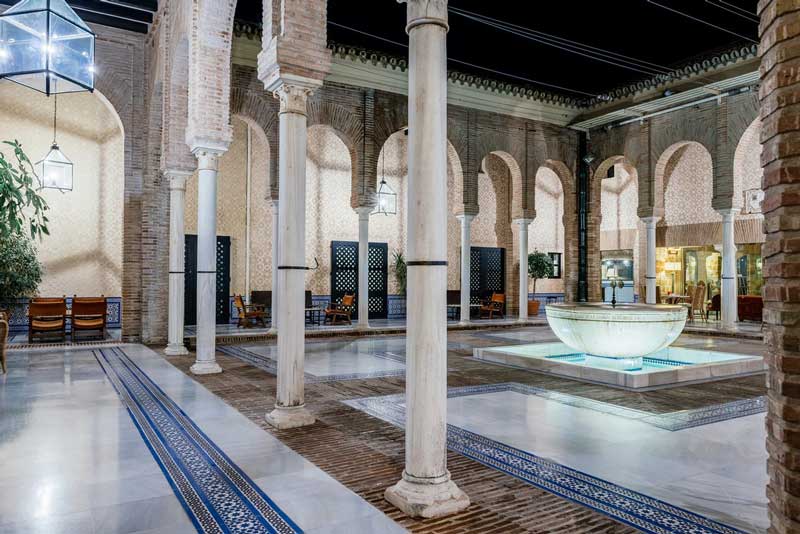
photo by: paradores.es
The Rooms – Where Even a King Could Have Slept
The rooms are historically inspired, naturally, but equipped with contemporary amenities, creating a perfect balance between nostalgia and comfort. The rooms are decorated in natural colors and furnished with quality, carved wooden furniture.
There are some nice touches, such as Andalusian tilework around the stone floors, as well as heavy wooden shutters – both referencing the castle’s rich heritage. But the star of the show here is the countryside view – beautifully framed from the arched stone windows.
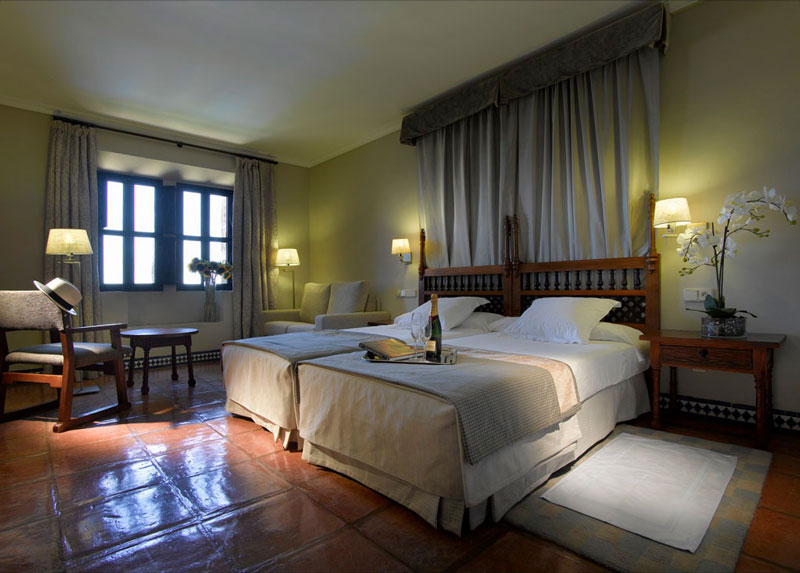
photo by: paradores.es
The rooms fall into two main categories. Standard Double Rooms have Juliet balconies, while Superior Double Rooms have larger outdoor spaces with seating. Each is equipped with flat-screen TV, safe, minibar, sitting area, air conditioning, and free Wi-Fi.
The bathrooms are executed in fresh white marble and traditional blue patterned tilework. Each has double sinks, toiletries, hairdryer, and a tub/shower combination, with separate WC and bidet. Some Superior Double Rooms also feature whirlpool bathtubs.
Those who are fortunate will end up in one of the rooms with a simply breathtaking panorama. In the morning, when the sun’s first rays run across the Andalusian plains, and in the evening, when the sunset bathes the landscape in gold – in both moments, it feels as if time has stood still.
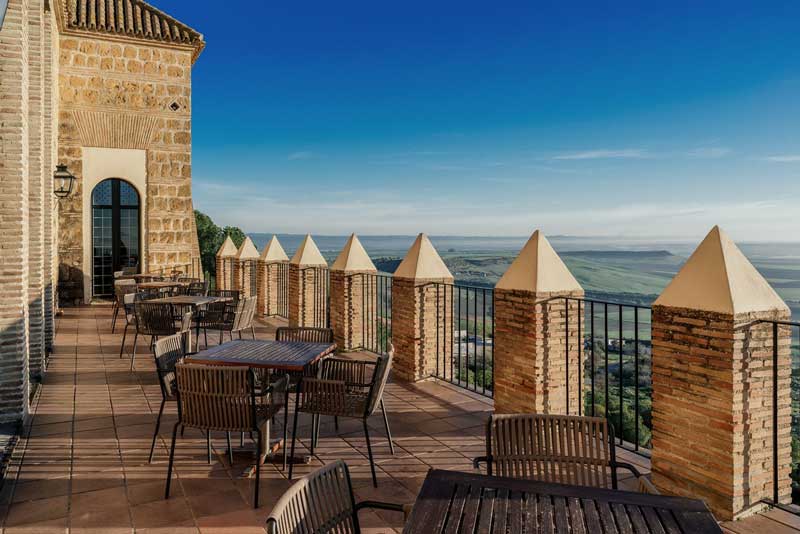
photo by: paradores.es
Dining as an Art
A special highlight of the hotel experience is the restaurant, which serves a classic Andalusian menu in the fort’s old refectory or outdoors on the terrace overlooking the countryside.
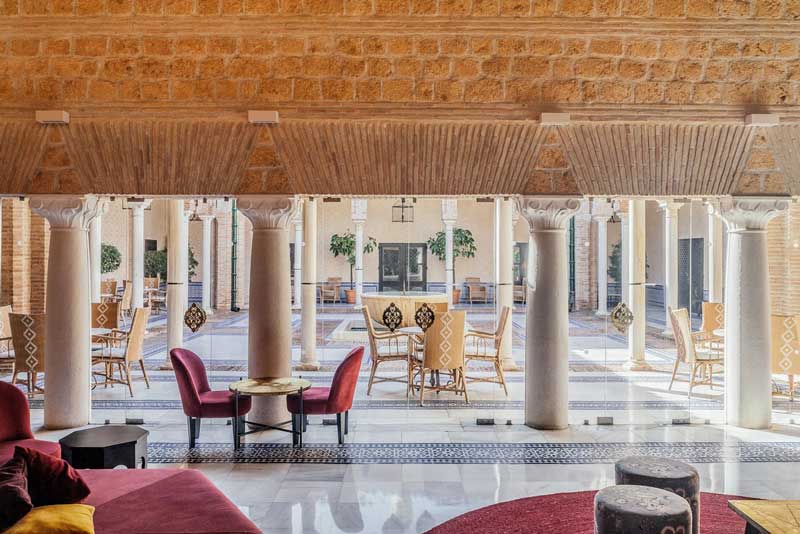
photo by: paradores.es
The restaurant, the former refectory, is one of the most spectacular dining rooms in the Parador network; it offers beautiful views of the pool and the luminosity of the Andalusian horizon. The restaurant serves succulent, seasonal, and local dishes: the partridge dinner and Carmona’s spiced spinach dishes are particularly outstanding.
Traditional dishes include excellent pastry work with a magnificent dessert buffet, as well as dishes based on partridge meat. The richness of Andalusian cuisine unfolds here in full splendor – the freshness of local ingredients, recipes passed down through generations, and careful preparation all contribute to making dining a true experience.
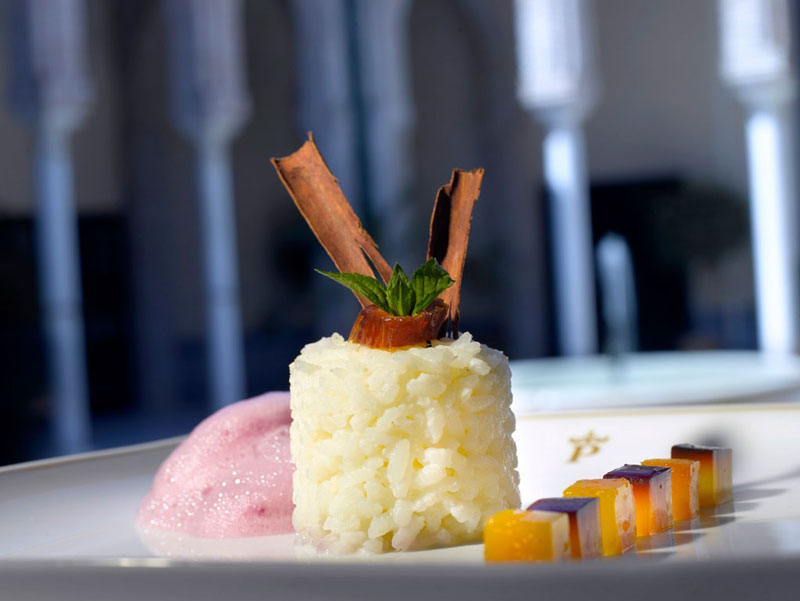
photo by: paradores.es
The grand dining hall features a beautiful vaulted ceiling, medieval-style chairs, and a calm, quiet atmosphere throughout. The heavy wooden tables, wrought-iron candelabras, and historical tapestries hung on the walls all create an atmosphere in which it is easy to imagine how nobles and kings dined here centuries ago.
The Pool and Gardens – An Oasis in History
The Parador de Carmona has a large outdoor pool that is open seasonally, with sun loungers and seating, as well as a separate children’s pool and poolside bar. It’s worth noting that the pool area is located at the base of the hill, down many steps.
The grounds are worth exploring, scattered with viewpoints and benches. Winding paths and walkways lead through the area, and around every corner, another beautiful view unfolds. Looking back at the castle from the pool, the sight is simply majestic – the imposing walls, above which the Andalusian sky is blue, and around which the flowering gardens flourish.
The gardens are carefully maintained, adorned with Mediterranean plants. Orange and lemon trees, lavender bushes, and palm trees provide that Mediterranean atmosphere so characteristic of Southern Spain. In the silence of the gardens, it’s easy to forget the outside world and just live in the here and now.
Exploring Carmona – The Town That Preserved Its Past
Staying at the Parador de Carmona is a great way to feel connected to the destination and feel part of traditional Spain. The fortification is within walking distance of many of the town’s attractions.
It’s a pleasure to walk the cobbled, winding streets and discover the magnificent architecture, shaded squares, and small bars and restaurants. The town is full of history: baroque palaces such as the Alonso Bernal Escamilla, Aguilar, Domínguez, and Lasso palaces, as well as the town’s two ancient entry points, including the intricately constructed Seville Gate.
A special experience not to be missed: the Convento de Santa Clara in Carmona sells traditionally baked goods. The goods can be purchased through a traditional revolving door – this is a memorable experience. The local cake, Torta Inglesa, is a dense and delicious pastry reportedly made according to the favorite recipe of an English archaeologist who conducted excavations at the nearby Roman necropolis centuries earlier.
Why Choose the Parador de Carmona?
There are many answers to this question, but perhaps the most important is simple: because here the past is not a museum piece, but a living reality. The Parador de Carmona is one of the most famous Paradores, and one of the best. It is located in the charming hilltop town of Carmona, not far from Seville (an excellent base for exploring the city), at the top of the town, with spectacular views of the Seville-Córdoba plain.
This is a historic building that retains many of its original features, including its bedrooms. The views from some rooms are stunning. Guests have frequently highlighted that the staff is friendly and helpful, and the food in the restaurant is excellent.
Often when exploring interior southern Spanish itineraries, routes focus on the major cities of Seville, Córdoba, or Granada, but Carmona should not be forgotten. Including the Parador de Carmona will be a welcome addition to an Andalusian grand tour.
Practical Information
The Parador offers 63 rooms, including 51 twin, 9 double, and 3 single rooms. Prices typically range from $100-350 per night (in 2025), depending on the season and room type chosen.
The hotel features a seasonal outdoor pool, poolside bar, restaurant, and café. Free Wi-Fi is available throughout the property, and free parking is provided within the castle walls.
The Parador is an especially good choice for couples seeking a romantic getaway, families who appreciate spacious rooms and a peaceful environment, and history enthusiasts looking for an authentic medieval experience.
The Silence of Eternity
As one sits on the Parador’s terrace, with a glass of fine local wine in hand, watching the sun slowly set over the Andalusian plain, it’s hard to believe that all this is real. The stone walls that surround us have seen kings and queens come and go, wars and peace, love and betrayal.
On June 22, 1993, the alcázar was declared property of cultural interest, ensuring that this extraordinary place would be preserved for future generations as well. And indeed, every guest who spends a night here is not just a hotel visitor but becomes part of this more than six-hundred-year-old story.
The Parador de Carmona is not merely a place where we stay. It is an experience that changes us. When we leave through the massive archway and return to the modern world, we take with us a piece of the past, a piece of history – and the knowledge that for a brief time, we too were part of something greater than ourselves and more timeless than any fleeting moment.
Here, at the summit of Carmona, history is not past tense. It is a living, breathing reality, waiting to be discovered.
__________________________________________________
For more Andalusia tips, follow us on Pinterest! 🧡