
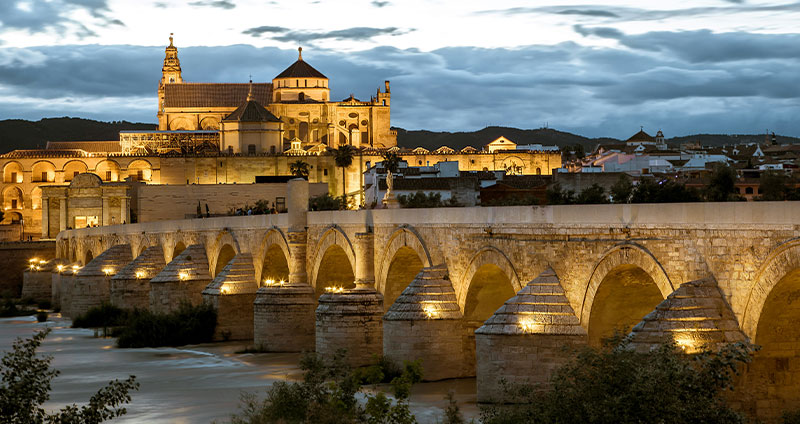
Standing at the entrance of Córdoba’s Mezquita-Catedral, I felt this strange sensation for the first time – as if I were standing at the border of two worlds, where time doesn’t move in a straight line but spirals around, where the past hasn’t passed but lives on in layers.
It was a summer morning, the July heat was just beginning to build, when I stepped through the gate of the orange tree courtyard. The air was filled with the sounds of the awakening city, but as I entered the semi-darkness of the mosque, all noise died away. Instead, I heard something else – a deep, ancient silence that isn’t the absence of sound but rather the accumulated whispers of centuries.
The Magic of the Forest of Columns
I’ll never forget the moment when my eyes adjusted to the dim light and I saw them. Hundreds, thousands – red-and-white striped arches in an endless forest, extending in every direction, as if someone had turned a kaleidoscope to gigantic proportions. You lose your sense of direction in this space. I don’t know which way is north or south, only that I’m standing in the middle of something extraordinary.
Eight hundred and fifty-six columns. That’s what my guidebook said. But when you stand among them, numbers mean nothing. Every column is different – some are pink marble, others jasper or granite. Each comes from somewhere else, each a piece of a vanished empire. They brought them from Roman temples, Visigothic basilicas, who knows what ancient buildings. And now they stand here together, bearing this marvelous burden.
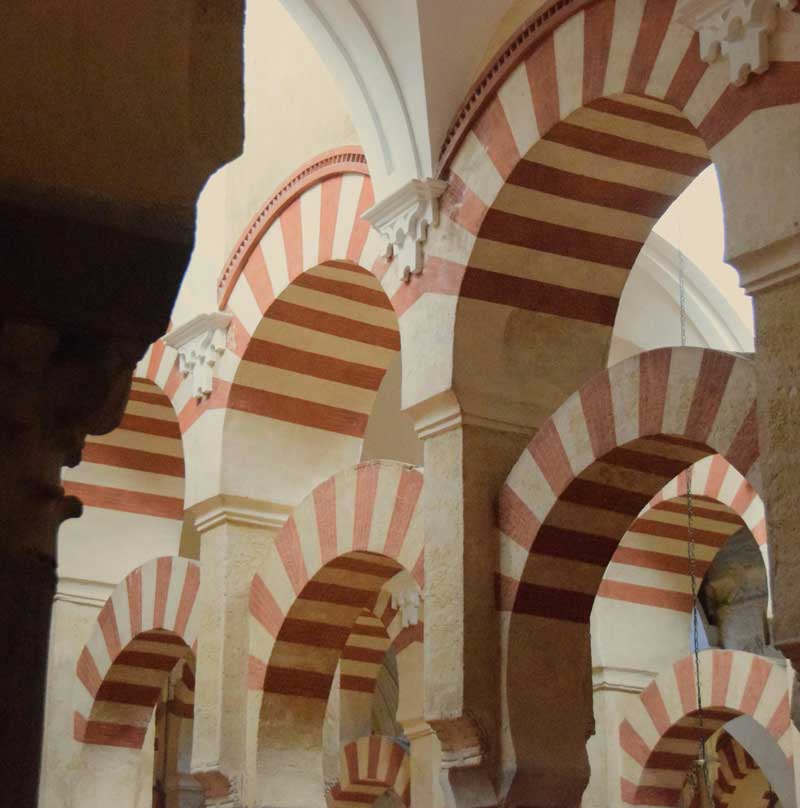
The alternating red brick and white stone in the arches is like some hypnotic pattern. I later learned this wasn’t by chance – it’s characteristic of Umayyad architecture, originating from Damascus. But in that moment I didn’t know and didn’t care about the historical explanation. I just watched as my eyes followed the arches, weaving into each other, disappearing into an infinite perspective.
Abd al-Rahman’s Dream
The story, as I later learned, begins with a refugee. Abd al-Rahman I, the Umayyad prince who miraculously escaped when his family was massacred in Damascus. I imagine him wandering for years, westward, ever westward, until he finally reaches the shores of Iberia. In 756, he conquers Córdoba and becomes emir.
But for an emir, power isn’t enough – he needs symbols too. And what could be a stronger symbol than a mosque that surpasses everything he’d ever seen? In 784, he begins its construction.
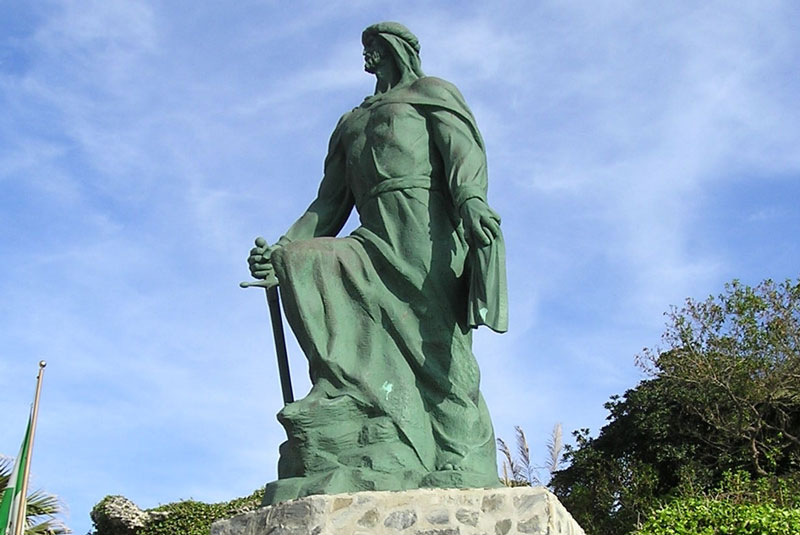
photo by: Noel Walley
Standing among those rows of columns, I tried to imagine what it must have been like to witness this construction. The workers dismantling old Roman buildings to obtain columns. The architects finding a brilliant solution to their problem – the columns are too short, so they build another arch system on top of them. And thus was born that double-arch construction that remains unique in the world.
Layers Upon Layers
But Abd al-Rahman’s mosque was only the beginning. Every subsequent ruler added something. His son expanded it, his grandson built a minaret. Then came Abd al-Rahman III, who in 929 did nothing less than proclaim himself caliph. Córdoba was no longer simply the capital of an emirate – this was the center of the western caliphate, rivaling Baghdad and Constantinople.
And the city flourished. Three hundred thousand inhabitants – at a time when London or Paris were still villages. Three hundred mosques, countless libraries, baths, palaces. Córdoba was in the 10th century what Florence would later be in the Renaissance – the brilliant pinnacle of civilization.
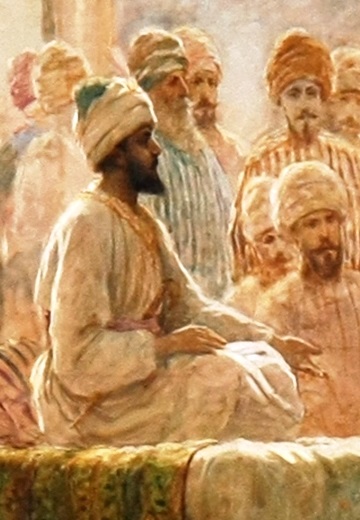
Abd al-Rahman III
But the true wonder was brought by Al-Hakam II. During his time, the mihrab was built – that breathtaking niche decorated with gold mosaics, pointing toward Mecca. When I first saw it, I almost cried. The way light plays on the gold, on the blue and green mosaics, makes you think you’re seeing an otherworldly realm. The Byzantine emperor sent the artists and materials – incredible, isn’t it? Christian Byzantium helping to build the greatest treasure of an Islamic mosque, because the two empires mutually respected each other.
When Everything Changed
- A year that changed everything. Ferdinand III of Castile conquers Córdoba. The reconquista – the Christian reconquest – had reached the heart of al-Andalus.
I imagine that day. Christian armies enter the city, and their first action is to go to the mosque. But what do they do? They don’t demolish it. They don’t burn it. They simply reconsecrate it. The Mezquita is now a cathedral.
At first, they treat it gently. They create small chapels in the sides. An altar here, a shrine there. The mosque essentially remains, only now Christian services are held within it.
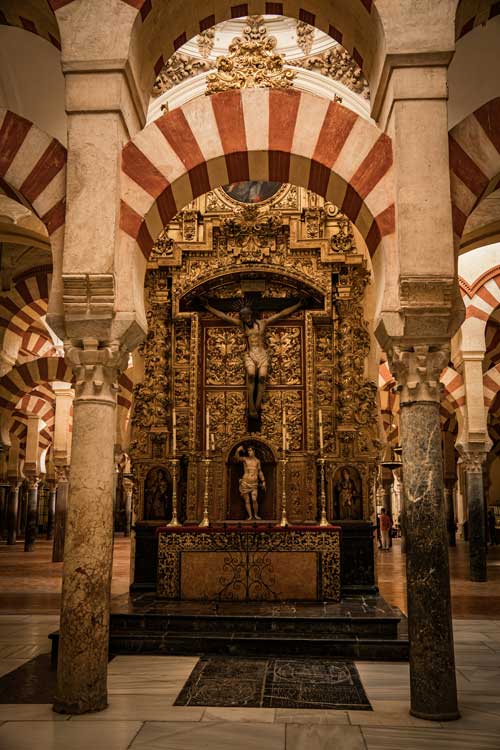
But then comes the 16th century. And comes a bishop, Manrique, who has bigger plans. In 1523, he receives permission from Charles V for something that shocked Córdoba’s inhabitants. They would tear out the center of the mosque and build a Renaissance cathedral into its heart.
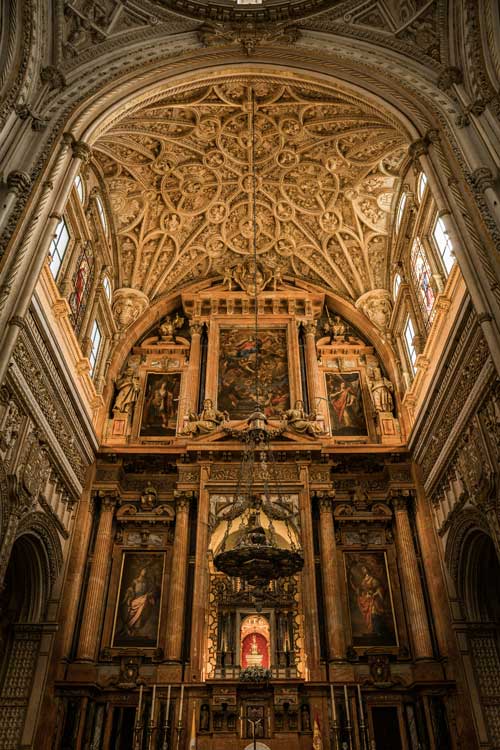
The city council protested. The people of Córdoba understood that what existed here was unique. But what does a city’s opinion matter against the will of the king and bishop?
Destruction and Creation
I’ve spent years trying to understand what those who witnessed this must have felt. As workers began dismantling the columns. As the red-and-white arches fell one after another. As the massive, open space – which for centuries had been the embodiment of Islamic spirituality – slowly gave way to a vertical, Christian construction.
There’s a legend that when Charles V finally personally visited Córdoba and saw what they’d done, he said to the bishop: “You have built what you could have built anywhere else, but what was here was unique in the world.”
I don’t know if this story is true. But I want to believe it is. Because there’s something redemptive in it – the recognition that we made a mistake, even if it’s too late to undo it.
Two Worlds Under One Roof
Today, when you walk through the Mezquita, you experience – or endure – this duality with every step. In the first moments, the Islamic space welcomes you. The forest of columns, the endless horizontality, the feeling that God is everywhere, not just at one point, but dispersed throughout the space.
Then you walk forward, and suddenly the Christian cathedral opens before you. High vaults reaching toward heaven. Carved choir stalls, altars, paintings. The verticality pointing skyward, which says: God is above, and we look up with humility.
The contrast is difficult to process. Some say this is vandalism. Others say it’s the perfect metaphor for Spain’s history – different cultures that don’t exclude but overlap each other.
Me? I don’t know. With each visit I feel something different. Sometimes anger – how dare they mutilate such a perfect space? Sometimes admiration – how brave this decision was, such a radical unification of two worlds. And sometimes just sadness – that humans always feel they must destroy to create something new.
The Details Where the Devil Lives
If you have time – and you should make time! – notice the details. The gold mosaics of the mihrab, where each piece was placed by hand. The different color and pattern of each marble column. The rows of orange trees in the patio de los naranjos, where in summer the fragrance alone is enough to make you dizzy.
And if you climb the bell tower – which was once a minaret – for a moment see Córdoba as Abd al-Rahman might have seen it. The city’s rooftops, the winding Guadalquivir, the mountains in the distance. And below you this massive block, this building that has survived time, wars, religious fanaticism, and still stands.
What Tourists Don’t See
The Mezquita-Catedral today receives thousands daily. Tourist groups flood through it, checking it off their list of sights. But there’s something you can’t experience this way.
Go at dawn, when it’s just opening. When the crowds haven’t arrived yet, when the light filters differently through the orange tree courtyard. Sit among the columns and simply be. Listen to the silence – but it’s not really silence, we’re just too busy to hear what it’s saying.
And if you have the chance, stay for a mass. When Gregorian chant rises to the vaults, when Latin words echo under Islamic arches – that moment is something unspeakable. You don’t have to be a believer to feel it: something sacred is happening here, something that transcends religions and ideologies.
Questions Without Answers
The debates surrounding the Mezquita-Catedral have never ceased. Muslim communities ask that the building’s original character be better respected. Some want Islamic prayer to be permitted in the building as well. The church says: this is a cathedral, for more than 780 years, an active place of worship.
Who’s right? I don’t know. And perhaps that’s the point – there’s no simple answer. History isn’t black and white. Buildings aren’t simply stones – they’re parts of our past, our identity. And when two pasts, two identities meet in the same space, there will always be conflict.
But maybe that’s not a bad thing. Maybe the Mezquita-Catedral is valuable precisely because it doesn’t offer easy answers. Because with each visit we must think again about what it means to preserve the past, what it means to respect different traditions, what it means to live together with those who believe differently, who see the world differently.
Return
I’ve been to Córdoba three times now, and three times I’ve spent hours in the Mezquita. And each time I took something different away with me. First, pure wonder – that such a thing could exist. Second, sadness – for what we’ve lost. Third, something deeper, hard to put into words – perhaps a kind of hope that if this building survived the storms of history, then perhaps we too can survive our own conflicts.
If you ever visit Andalusia, don’t let the Mezquita-Catedral be just another sight on your list. Let it be a pilgrimage. A journey through time, space, between cultures. Go to slow down, to think, to feel.
Because ultimately, this is what this place gives us: not answers, but better questions. Not reassurance, but contemplation. Not simplicity, but the beauty of complexity.
And when we step out through the gate, returning to the noise of the modern world, we carry something with us – a memory, a feeling, a quiet inner voice whispering: it can be different. It can be together. It can be beautiful, even when it’s not perfect.
__________________________________________________
For more Andalusia tips, follow us on Pinterest! 🧡