
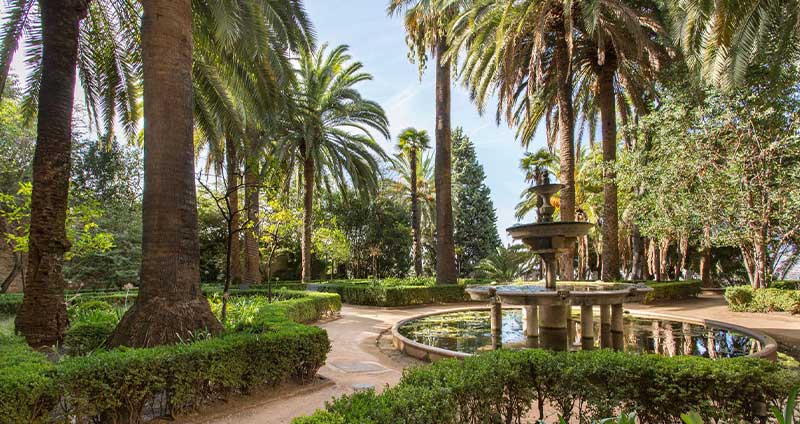
At the foot of Granada’s hills, where the snow-capped peaks of the Sierra Nevada stand guard over the city, there exists a place that seems to have stopped in time. Carmen de los Mártires is not merely a garden – it is a living history book, where every tree, every fountain, and every stone step preserves a chapter of Granada’s turbulent past.
When I first stepped through the garden gate on a mild spring morning, I immediately sensed that I had arrived somewhere special. Just minutes away from the city’s noise, beneath the proud walls of the Alhambra, lies this secret paradise that most tourists never discover. Yet those who skip it miss out on exploring one of Granada’s most moving treasures.
The Garden of Martyrs: The Mysterious Origin of the Name
The Carmen de los Mártires – literally “the estate of the martyrs” – has origins shrouded in the mist of legends, and this is one of the things that lends such a magical atmosphere to the place. The most well-known story suggests that during Moorish rule, a prison once stood on the site of the garden, where Christian captives were held. These prisoners, who suffered and died for their faith, became martyrs, and allegedly the area received this sentimental name in memory of them.
Another legend tells that when the Catholic Monarchs, Ferdinand and Isabella, conquered Granada in 1492, the last refuge of the Moorish rulers was precisely here, at the foot of the Alhambra. According to the story, the Muslim families who remained, unwilling to leave their ancestors’ land, chose martyrdom rather than exchange their faith and identity.
But the most romantic version involves a love story. The tale speaks of a Christian knight and a Moorish princess whose love was impossible due to the chasm between their two worlds. When the knight was captured and executed, the princess buried him here, in this very place, and planted a garden in his memory, where every flower was a tear she shed for the loss of her beloved.
The Garden’s Birth: After Christianity’s Triumph
The factual history is no less exciting than the legends. After the reconquista ended in 1492, Granada fell into Christian hands. The city’s new masters quickly set about reshaping the former Moorish capital in their own image. The territory of Carmen de los Mártires was donated to a monastic order, who built a monastery here in the 16th century.
The Carthusian monks chose this location for their strict way of life and contemplative nature. In the shadow of the Alhambra, isolated from the city’s noise, they found the perfect environment for prayer and meditation. The monks created the first gardens, which they used for agricultural purposes and their own sustenance. These early gardens were simple and functional – medicinal herbs, vegetables, and fruit trees lined the space, rather than decorative elements.
In the 19th century, however, everything changed. During the secularization of monastic orders, the estate was transferred to private ownership. It was then that the property came into the hands of a wealthy Granada family, the Aguilars, who possessed both vision and passion for the art of gardening.
The Romantic Transformation: When the Garden Became Art
The Aguilar family didn’t simply maintain the garden – they recreated it. In the mid-19th century, when romantic garden art flourished in Europe, when the styles of English landscape gardens and French formal gardens merged into new, eclectic creations, Carmen de los Mártires became the site of just such an ambitious project.
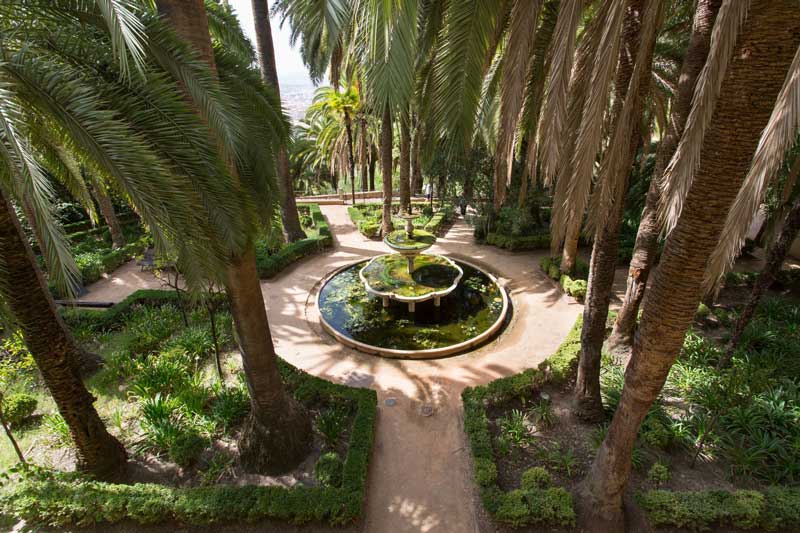
photo by: jardinesdegranada
The family, inspired by European gardens encountered during their travels, created the extraordinary composition we can still see today. They developed French-style formal gardens with geometric beds, carefully trimmed hedges, and symmetrical walkways. At the same time, they incorporated English landscape garden elements: romantic paths, unexpected viewpoints, picturesque ponds, and fountains.
But what truly makes Carmen de los Mártires special is the respect for Moorish tradition. The designers didn’t try to completely erase the site’s Andalusian identity. On the contrary, they erected beautiful Nasrid-style pavilions, created mosaic-decorated patios, and water – the central element of Islamic garden art – is present everywhere.
A Walk Through Time: The Garden’s Special Spaces
When we wander through the garden today, we’re actually discovering several different worlds that harmoniously blend into one another. Starting from the main entrance, the neoclassical mansion, the Carmen, immediately catches the eye, which also functions as a museum. Around the building, French-style gardens spread out, where geometry and symmetry reign.
As we descend, we’re immersed in the atmosphere of an English romantic garden. Beneath the shade of massive cedars, winding paths lead us, and among the trees, peacocks roam freely – because yes, one of this garden’s charms is that peacocks live here, who to visitors’ greatest delight spread their magnificent plumage.
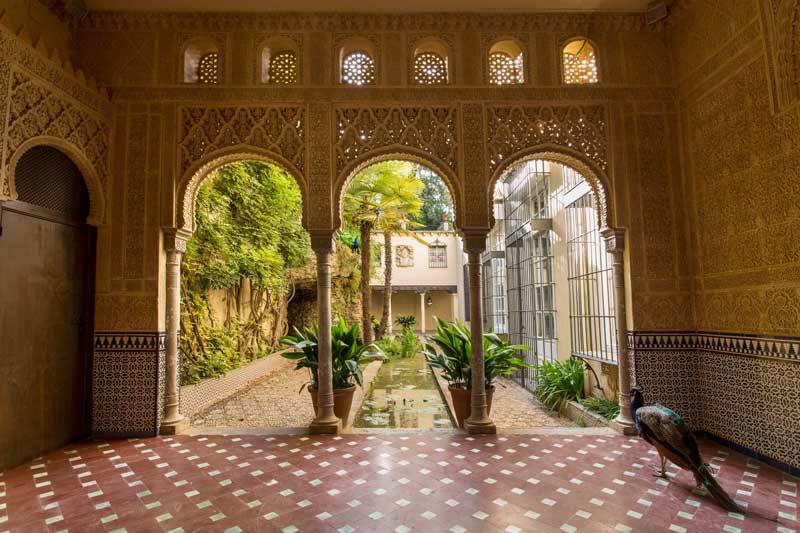
photo by: jardinesdegranada
The atmosphere around the ponds is particularly magical. In the water’s reflection, the reddish hues of the Alhambra’s walls shimmer, and if we’re lucky, besides the occasional peacock, we can observe turtles basking in the sunshine on the shore.
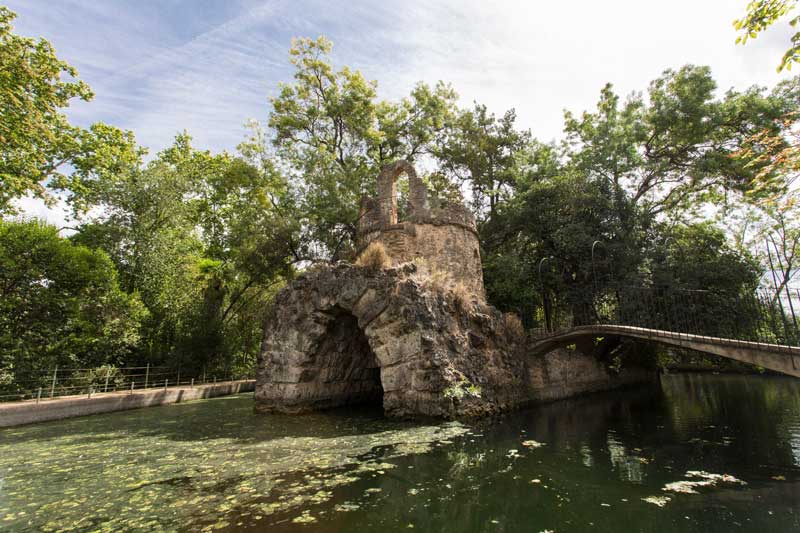
photo by: jardinesdegranada
But for me, the most moving part of the garden is the Nasrid patio. This small, intimate space is a perfect homage to Moorish garden art. At the center sits an octagonal pool, surrounded by mosaic-decorated columns, and everywhere the murmur of water. Sitting here, intoxicated by the fragrance of orange blossoms, it’s easy to imagine what this landscape must have been like centuries ago, when the Nasrids ruled Granada.
Legends in the Garden’s Depths
Every old garden has its ghosts, and Carmen de los Mártires is no exception. Over the centuries, countless stories have woven around the place, further enriching the experience.
Many locals speak of a white figure who walks among the gardens on moonlit nights. Some say it’s the spirit of one of the Aguilar family members, who loved this place so much that even after death couldn’t leave it. Others believe it’s the ghost of the Moorish princess, still searching for her knight among the trees.
There’s another legend about a hidden treasure. Allegedly, during the reconquista, a Moorish nobleman who knew the city’s end had come hid part of his treasury somewhere on this territory. The story says that on a moonless night, a star reveals the treasure’s location, but only to those with pure hearts and true intentions.
When I first heard these stories, I was capable of spending hours exploring the garden’s more hidden parts, hoping to find that certain place. Of course, I didn’t find treasure, but I found something else: the treasure of tranquility, the treasure of recognizing beauty, and the value of knowing there’s a place in the world where time passes more slowly.
The Garden as Sanctuary
The uniqueness of Carmen de los Mártires lies not only in its history or aesthetics but also in the role it plays in the lives of granadinos. While the Alhambra attracts tens of thousands daily, this garden has preserved its intimacy and peace.
As visitors, we can observe local families arriving with picnic baskets on Sunday afternoons, lovers meeting in romantic corners, artists bringing their easels to capture the play of light filtering through the leaves. This isn’t a museum piece – it’s a living, breathing space that’s part of the city’s fabric.
In spring, when the roses bloom, the entire garden becomes one enormous cloud of fragrance. In summer, the cedars provide cool shade against the blazing Andalusian sun. In autumn, falling leaves paint the landscape in a riot of colors, and in winter, when snow rarely falls on Granada, the garden transforms into a fairytale setting, where Nasrid pavilions rest beneath a white blanket.
Why Does It Deserve More Attention?
I often wonder why this marvelous place isn’t better known. Perhaps that’s exactly what makes it so special – that it remains hidden from the crowds. But I feel this garden deserves to be discovered by more people, not to become a tourist spectacle, but because it represents values that are particularly important today.
Carmen de los Mártires is an example of how different cultures, different aesthetics, and influences from different eras can coexist harmoniously. Here, Christian, Moorish, and European traditions don’t clash but complement each other. This garden is living proof that diversity is not a weakness but a source of strength and beauty.
Pilgrimage to Beauty
When I now look back on that first visit, that spring morning when I first stepped through that gate, I understand that something more happened than a simple excursion. I made a kind of pilgrimage to the altar of beauty, peace, and history.
Carmen de los Mártires doesn’t try to impress with grandiose dimensions or excessive decoration. Its strength lies in its subtlety, in the tiny details that only reveal themselves if we take time for them. A piece of mosaic on a wall that time has almost completely worn away. An old tree’s roots clinging to a stone wall. A viewpoint from which suddenly the panorama of the Sierra Nevada unfolds.
This place teaches us to slow down, to look, and to feel. In today’s rushed world, where we experience everything quickly and superficially, the gift of Carmen de los Mártires is that it gives us back time. Time to wonder. Time to dream. Time to connect with what truly matters.
If you ever visit Granada, don’t miss this hidden treasure. Sit on the bench beside the Nasrid patio, listen to the murmur of water, watch the peacocks stride proudly, and let this timeless place tell you its story. Because Carmen de los Mártires isn’t just a garden – it’s a poem written not with words but with trees, water, and light.
The cover photo by: jardinesdegranada
__________________________________________________
For more Andalusia tips, follow us on Pinterest! 🧡