
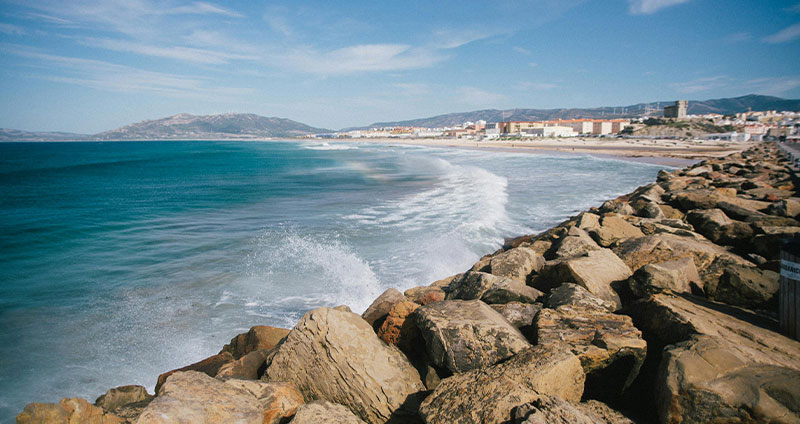
The wind never rests in Tarifa. I stand at Punta de Tarifa, the southernmost point of continental Europe, and feel the Levante – the eastern wind – whistling through the Strait of Gibraltar. Fourteen kilometers away, so close it seems almost within reach on a clear day, lies Africa. The mountains of Morocco are outlined in blue against the horizon. Two continents, two worlds – and here I stand in between, on that thin strip of land where the Atlantic Ocean meets the Mediterranean Sea.
Tarifa is not just a geographical point on a map. It’s a place where history, cultures, and natural forces collide, mix, and create something extraordinary.
The Legacy of Tarif ibn Malik
The city’s name tells the story of a man who changed history. Tarif ibn Malik, a Moorish commander who in 710 – even before the official Moorish conquest – led a reconnaissance expedition to these shores. A year later, in 711, Tariq ibn Ziyad followed him with a larger army, and the Islamic conquest of the Iberian Peninsula began, lasting eight hundred years.
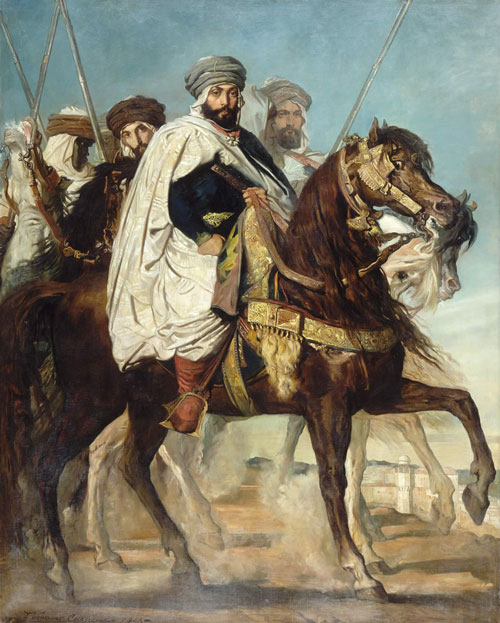
When I first visited Tarifa, I tried to imagine that moment. Tarif’s ships approaching the shore, the crew first seeing this strip of land that is so close to Africa, yet already Europe. What did they think? Did they know they were opening the gates to a conquest that would forever change the history of the peninsula?
The city that bears his name is filled with this ancient history. The Castle of Guzmán el Bueno – actually built by the Moors in the 10th century – still guards the port today. Within its walls, centuries echo: the Islamic architects who built it, the Christian knights who recaptured it, the sailors who sailed under its protection.
The City of Wind
But what perhaps defines Tarifa even more than its history is the wind. More than three hundred days a year, either the Levante blows here – the eastern wind from Africa – or the Poniente – the western wind from the Atlantic Ocean. The funnel effect of the Strait of Gibraltar accelerates these winds with a force that is shocking the first time.
I remember my first morning in Tarifa. I stepped out of the hotel and was nearly knocked over by the wind. My hair was blown horizontal, my clothes flapping. Everyone around me walked normally, as if nothing was happening. I learned later: the locals are so used to it that they don’t even notice anymore. The wind is part of Tarifa’s identity, like the air they breathe.
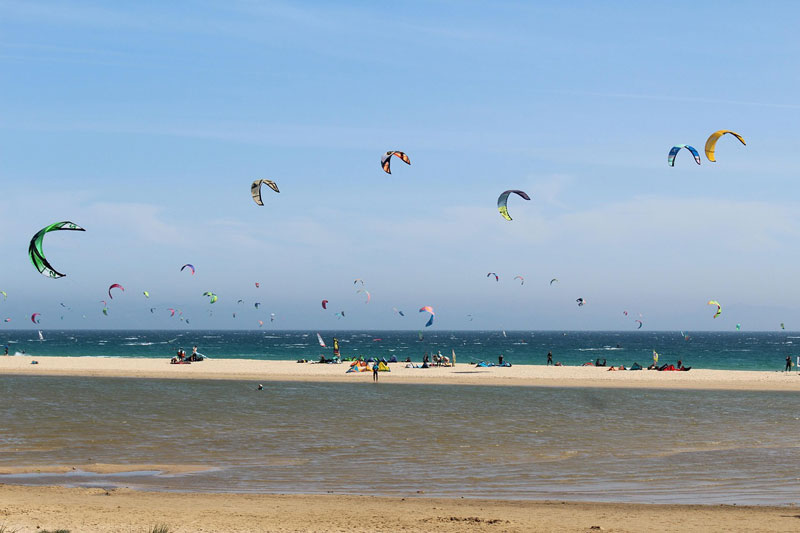
This wind made Tarifa the world capital of windsurfing and kitesurfing. The beaches of Playa de Los Lances, Valdevaqueros, and Punta Paloma are filled with colorful sails racing across the waves. Young people from all over the world come here to experience this adrenaline, this dance with the wind and water.
But the wind isn’t just a gift for surfers. The area around Tarifa is adorned with thousands of wind turbines, constantly rotating, generating energy. As I drove into the city, I was greeted by this modern Don Quixote-like sight – an endless field of modern windmills, slowly, hypnotically rotating beneath the sky.
Where Two Seas Meet
Punta de Tarifa – or as it’s sometimes called, Punta Marroquí – is the southeastern tip of the small island called Isla de las Palomas. A causeway connects it to the mainland, built in 1808. For decades, a military base operated here, until 2001, when mandatory military service was abolished in Spain.
Today you can walk along the causeway and stand at the point where continental Europe ends. This feeling is special. To the left, the Atlantic Ocean; to the right, the Mediterranean Sea. Two massive bodies of water embracing each other here. The color of the water is different on each side – the Atlantic darker, wilder; the Mediterranean calmer, bluer.
I stood there one afternoon, looking at the horizon, thinking. How many ships have passed by here over the centuries? How many traders, conquerors, refugees, explorers? This strait has always been one of humanity’s most important routes – a gateway between Europe and Africa, between the Atlantic Ocean and the Mediterranean Sea.
The Magic of the White City
But Tarifa is not just geography and history. It’s a living, breathing small town that has preserved its Andalusian character while also absorbing cosmopolitan energy from the international community of surfers.
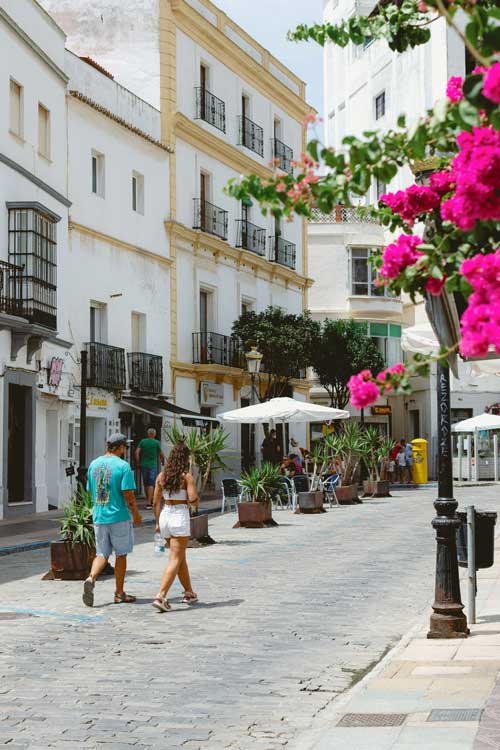
The old town – the Casco Antiguo – is filled with characteristic white Andalusian houses. Narrow streets wind around, flower-potted balconies hang above us, small squares appear unexpectedly. The Puerta de Jerez, the only remaining medieval gate, is a reminder of Tarifa’s old days, when walls protected the city from attackers.
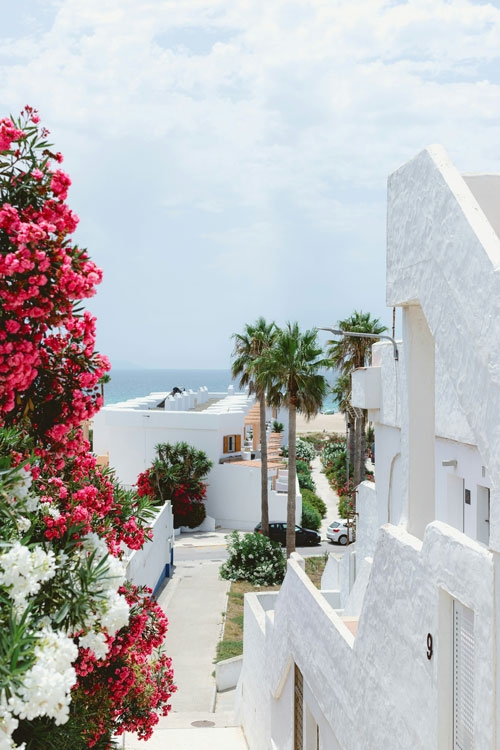
Walking these streets is like traveling through time. On one corner, a traditional Andalusian bar where old men play dominoes. On the next corner, a modern surf shop where young, dreadlocked people check the wave forecast. Next to an old church, a Moroccan tea house where the scent of mint mingles with the salty sea air.
This mixture – the traditional and the modern, the local and the international, the European and the African – makes Tarifa so special. This is not a museum city living in the past. It’s a place that lives, moves, changes, but meanwhile preserves its roots.
Gastronomic Treasures Between Two Seas
And then there’s the food. Oh, the food! Tarifa’s gastronomy is as rich as its history. Existing between two seas means that fresher seafood can hardly be found anywhere else.
The local pride is atún rojo – red tuna, caught using the traditional almadraba method. This is an ancient fishing technique that dates back to the Phoenicians and still lives on here in the waters of the strait. From May to early June, the Ruta del Atún – the tuna route – takes place, a gastronomic festival where every restaurant in the city showcases the best ways to prepare tuna.
The first time I ate tuna tataki in Tarifa, time stood still. The fish was so fresh it practically melted in my mouth. The outer layer lightly seared, the inside still almost raw, tender. Alongside it, soy sauce, wasabi, a hint of ginger. Simple, but perfect.
But beyond tuna, countless other seafood delicacies await. Clams in garlic sauce, fried squid, sea bass baked in salt, shrimp omelet – called tortillitas de camarones, a crispy, heavenly delicacy.
And of course, there are the traditional Andalusian dishes as well. Gazpacho in summer, cooling and refreshing. Salmorejo – a thicker, creamier version from Córdoba. Rabo de toro – oxtail stew that has cooked for hours until the meat practically falls off the bone.
What I particularly love about Tarifa’s restaurants is the diversity. You’ll find traditional Spanish taverns where elderly waiters still remember what you drank ten years ago. You’ll find modern fusion places where Spanish flavors mix with Asian or Latin American influences. And you’ll also find Moroccan restaurants – after all, Africa is so close – where the aroma of tagines and the sweetness of mint tea transport you to another world.
One of my favorite rituals: sitting in a small tapas bar near the port in the late afternoon. A glass of local wine, some tapas – jamón serrano, manchego cheese, marinated olives. Watching the fishing boats as they come home, listening to the seagulls’ cries, feeling the sea breeze on my face. This is when I feel: Tarifa is not just a place. It’s a way of life.
Natural Wonders
The area around Tarifa is filled with stunning natural beauty. The Parque Natural del Estrecho – the Natural Park of the Strait – offers opportunities for bird watching. This is one of the best places in Europe to see migratory birds as they cross to Africa and back. Storks, vultures, falcons – thousands fly through here every year.
A few kilometers from the city is Bolonia – a tiny coastal village where Roman ruins can be found. Baelo Claudia, an ancient Roman settlement where columns still stand, the ruins of a theater, mosaics. Walking among these ruins, hearing the murmur of the sea in the background, is a strange feeling. The Romans also stood here two thousand years ago, looking at the same sea, the same African coast in the distance.
And then there are the beaches. Oh, those beaches! Kilometers of white sand, turquoise water, dunes that the wind constantly shapes. Walking on Playa de Los Lances as the sun sets into the Atlantic Ocean, you feel like you’re in the most beautiful place in the world.
Tarifa Today: The Dance of Tradition and Modernity
Today Tarifa is a city that balances between two worlds. A small Andalusian fishing village that has preserved its traditions, and an international surf paradise that attracts people from all over the world.
In summer, the city is full of life. The beaches are crowded with surfers, the bars filled with young people, the air filled with music and laughter. But in winter, when the tourists leave, Tarifa regains its quieter self. This is when the locals reclaim the streets, the restaurants are calmer, and there’s time to truly understand the soul of the city.
What has always fascinated me about Tarifa is how it has maintained its authenticity. Many other Andalusian coastal towns have become over-touristed, losing their character. But Tarifa has somehow found the balance. Yes, there are tourists. Yes, there is development. But the soul of the city remains.
Epilogue in the Wind
On my last evening in Tarifa, I climbed up to the castle walls, from where the entire city is visible. The sun was just setting, casting golden light on the white houses. Below me, fishing boats swayed in the port. In the distance, the silhouette of Africa slowly faded in the twilight.
The wind, as always, was blowing. But now I felt it not as a stranger, but as an old friend. The Levante whispered stories – of Tarif ibn Malik, who first set foot on these shores. Of the Christian knights who recaptured it. Of the fishermen who sailed out from these waters for generations. Of the surfers who brought new life.
Tarifa is more than Europe’s southernmost point. It’s a place where past and present, east and west, land and sea meet. Where the wind always blows, but it’s not an obstacle – it’s freedom. Where the tuna is fresh, the wine is good, and people still take time to sit down, talk, enjoy the moment.
If you ever go there, don’t go just as a tourist. Go in a way that lets the wind carry you. Sit in a bar, order a glass of wine and some tapas. Talk to people. Walk the beaches. Stop at Punta de Tarifa and look at Africa. And let this special little town tell you its story – not in words, but through wind, sea, and tuna.
Because ultimately, Tarifa teaches us this: that the most beautiful places are not those where everything is perfect, but those where different elements of the world meet, collide, and create harmony. Where the wind is not a problem, but a gift. Where standing between two continents, you understand: we all live on one continent. And that continent is not geographical – it’s human.
__________________________________________________
For more Andalusia tips, follow us on Pinterest! 🧡